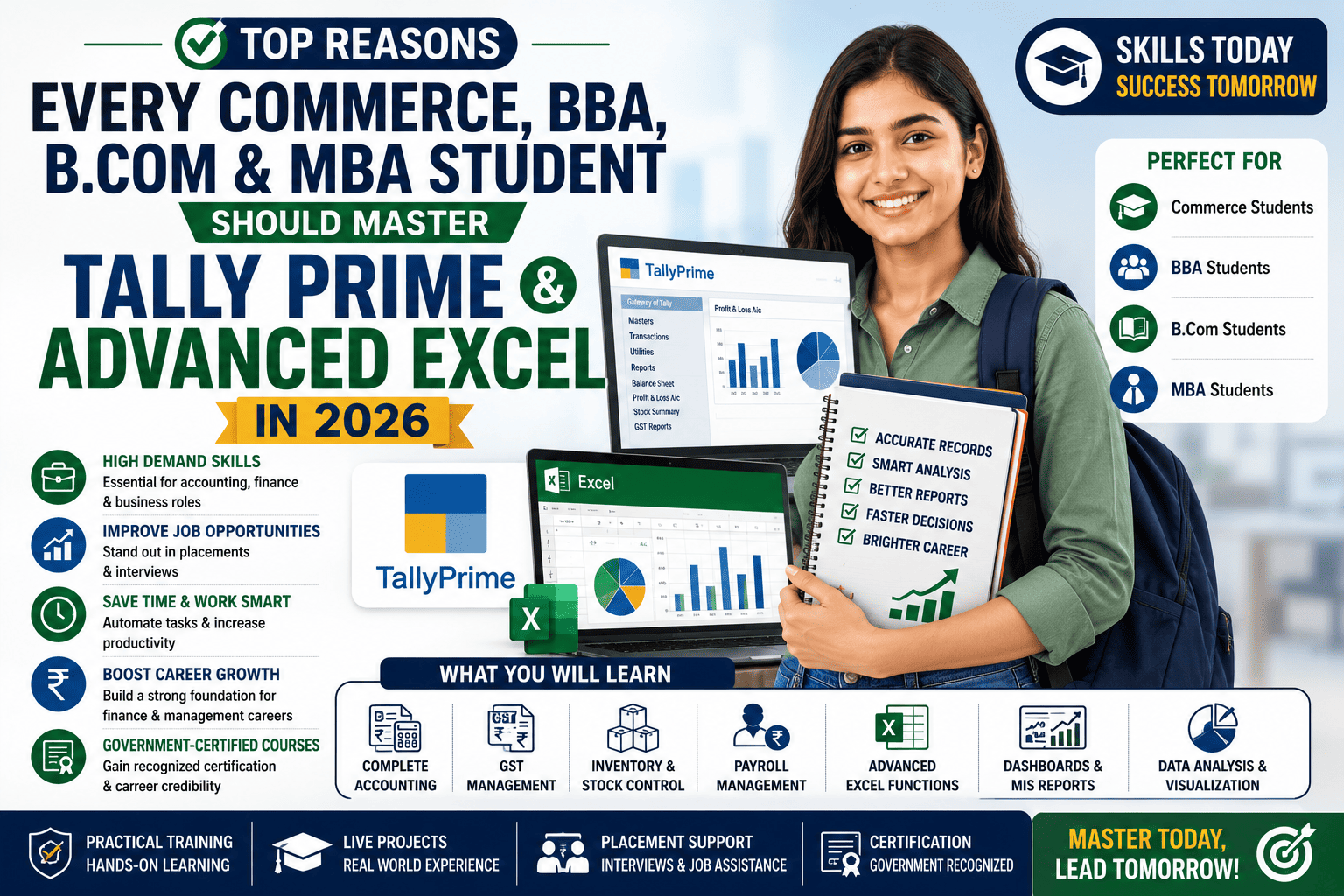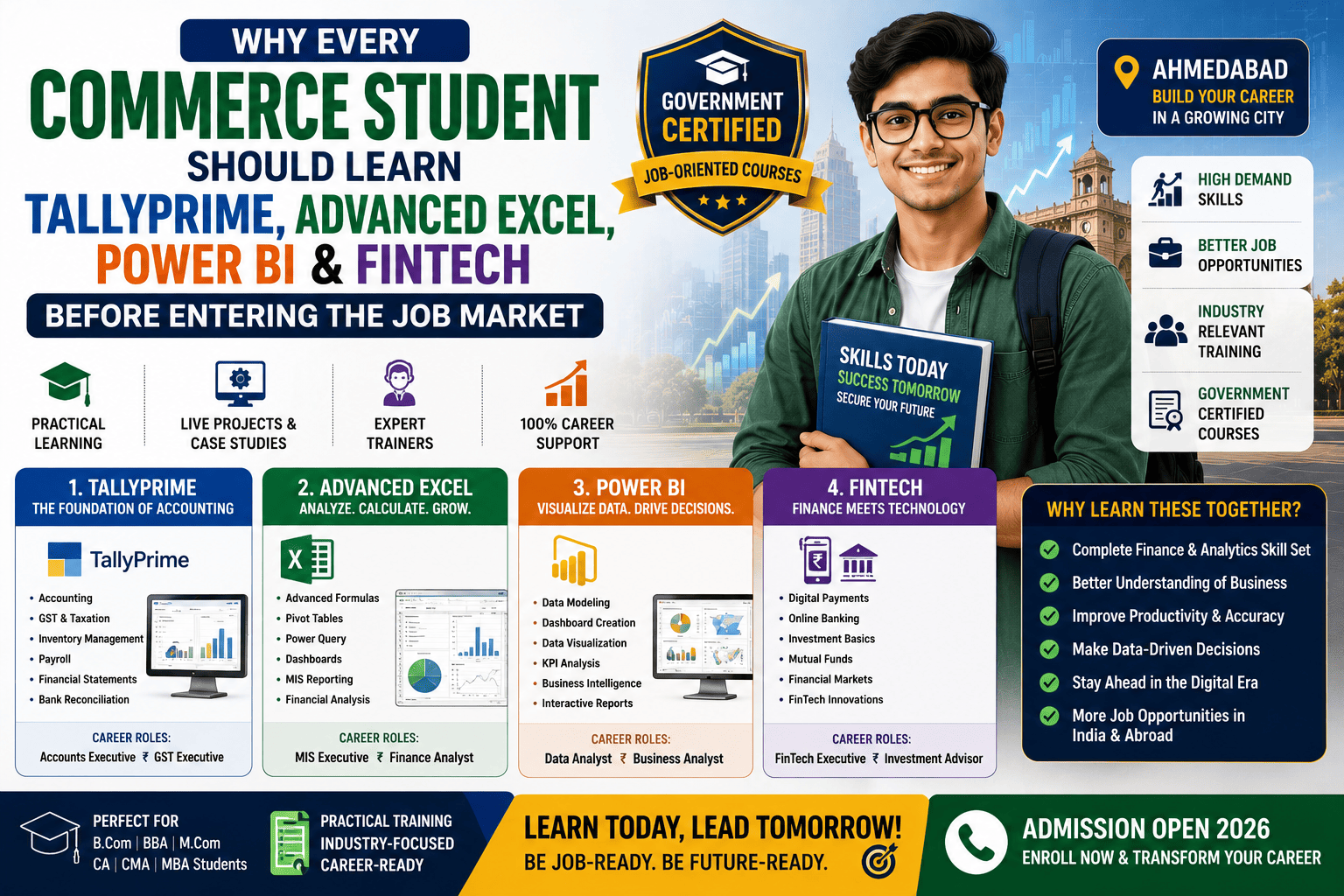
A Commerce degree provides a strong understanding of accounting, finance, taxation, economics, and business management. However, in today’s competitive job market, employers expect more than theoretical knowledge. They are looking for graduates who can confidently use accounting software, analyze financial data, create business reports, and understand modern financial technologies.
For students pursuing Commerce, B.Com, BBA, MBA, M.Com, CA Foundation, CMA, and other finance-related programs, learning TallyPrime, Advanced Excel, Power BI, and FinTech before entering the job market can significantly improve career opportunities and workplace readiness.
This guide explains why these four skills are becoming essential for finance professionals in 2026, how they complement academic education, and why government-certified practical training can help students build successful careers.
Why the Commerce Job Market Is Changing in 2026
The finance and accounting industry is undergoing rapid digital transformation. Businesses are replacing manual processes with cloud-based accounting systems, business intelligence tools, automation, and digital financial services.
Today’s employers expect commerce graduates to:
- Use accounting software efficiently
- Prepare GST-compliant financial records
- Analyze business performance
- Create interactive dashboards
- Generate MIS reports
- Understand digital payments and financial technologies
- Support business decision-making using data
Students who possess practical software skills often have an advantage during internships and recruitment.
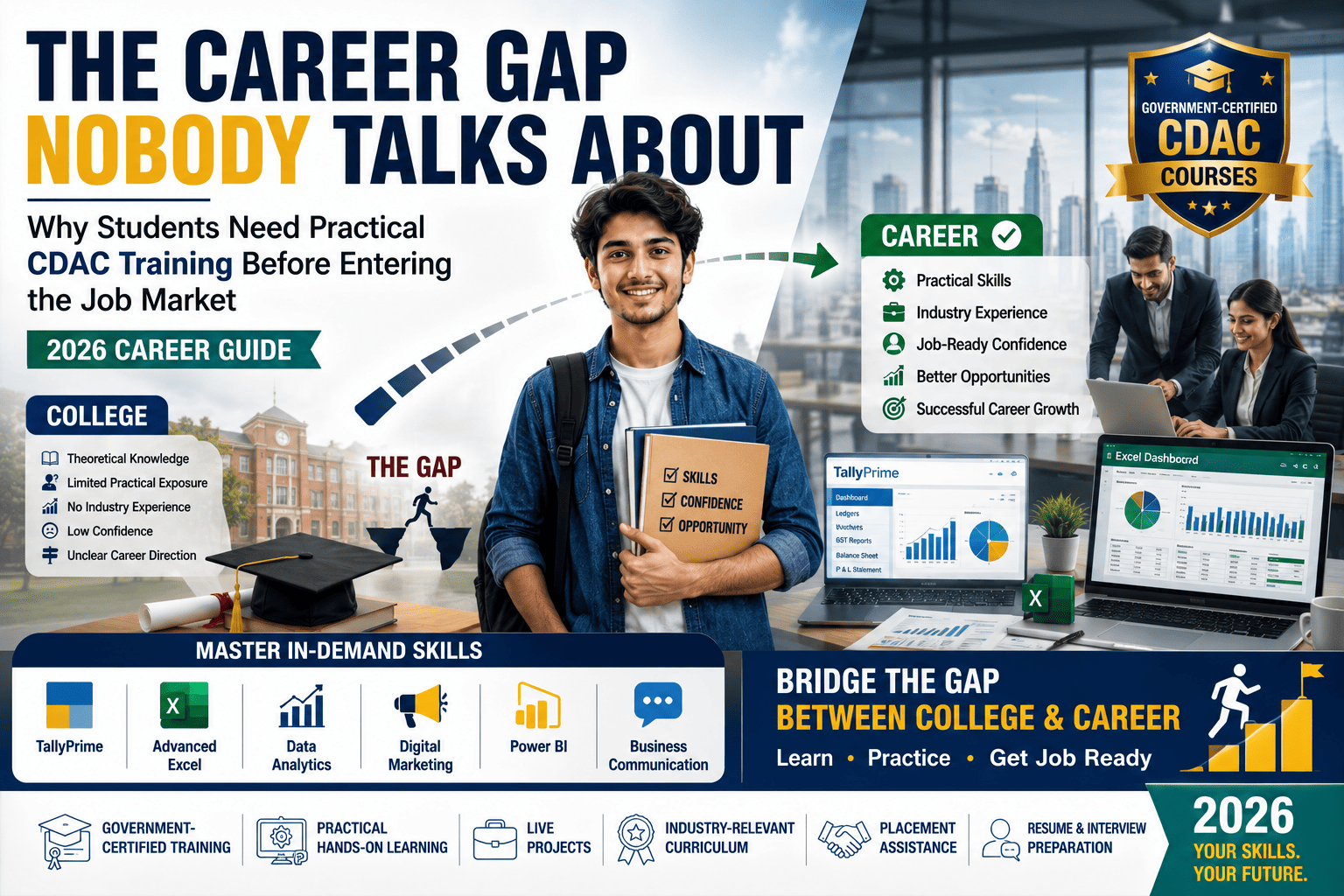
Why Practical Skills Matter Alongside a Commerce Degree
A university curriculum teaches important business concepts, but companies also expect graduates to apply those concepts using modern business tools.
Practical skills help students:
- Gain confidence before interviews
- Improve internship opportunities
- Build stronger resumes
- Perform workplace tasks efficiently
- Adapt to digital accounting systems
- Become job-ready before graduation
Learning industry-standard software during college bridges the gap between classroom learning and real-world employment.
TallyPrime: The Foundation of Modern Accounting
TallyPrime continues to be one of India’s most widely used accounting and business management software applications.
Skills Students Learn
- Company Creation
- Ledger Management
- Voucher Entry
- GST Accounting
- Inventory Management
- Payroll
- Banking
- Cost Centres
- Financial Statements
- Balance Sheet
- Profit & Loss Reports
Career Opportunities
- Accounts Executive
- GST Executive
- Billing Executive
- Payroll Executive
- Finance Executive
- Audit Assistant
TallyPrime helps students transform accounting theory into practical workplace experience.
Advanced Excel: The Most Requested Business Skill
Advanced Excel is used in almost every finance and business department.
Students Learn
- IF & Nested IF Functions
- XLOOKUP & VLOOKUP
- INDEX & MATCH
- Pivot Tables
- Power Query
- Data Validation
- Dashboard Creation
- MIS Reporting
- Financial Analysis
- Conditional Formatting
Used In
- Finance
- Banking
- HR
- Operations
- Sales
- Administration
- Auditing
Excel improves productivity and enables professionals to manage business data more effectively.
Power BI: From Data to Business Intelligence
Companies increasingly depend on visual dashboards and real-time reporting to make business decisions.
Power BI enables students to:
- Analyze business performance
- Create dashboards
- Monitor KPIs
- Visualize financial data
- Build interactive reports
- Present business insights
Career Opportunities
- Data Analyst
- Business Analyst
- MIS Executive
- Reporting Executive
- Financial Data Analyst
Power BI complements Excel by transforming raw information into actionable insights.
FinTech: Understanding the Future of Finance
Financial Technology (FinTech) is reshaping banking, investments, insurance, and payment systems.
Students gain knowledge about:
- Digital Payments
- UPI Ecosystem
- Online Banking
- Mobile Wallets
- Financial Markets
- Mutual Funds
- Investment Planning
- Wealth Management
- Financial Products
- Digital Financial Services
Understanding FinTech prepares students for the future of digital finance.
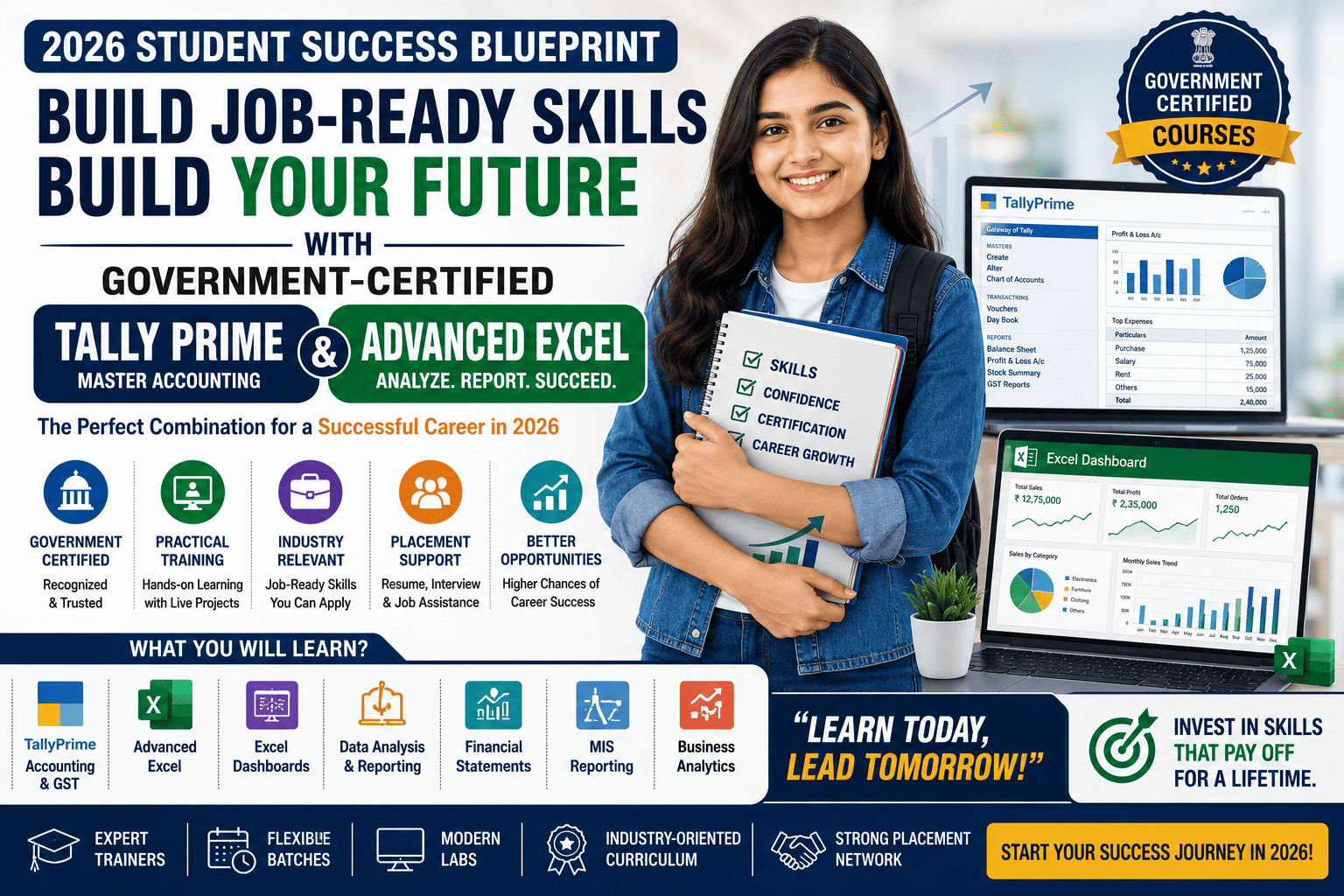
Why Learning These Four Skills Together Makes You More Employable
Each skill supports a different aspect of modern finance.
- TallyPrime builds accounting and GST expertise.
- Advanced Excel improves reporting and financial analysis.
- Power BI transforms data into business insights.
- FinTech introduces students to digital financial ecosystems.
Together, they help students:
- Manage accounts efficiently
- Analyze financial performance
- Create professional dashboards
- Understand financial technology
- Support strategic business decisions
- Improve operational efficiency
This combination makes graduates more valuable across finance and business functions.
Why Government-Certified Practical Training Matters
Government-certified career-oriented programmes focus on practical application and workplace readiness.
Depending on the institute and programme, learners may receive government-recognised or industry-recognised certification after successful completion.
Benefits Include
- Hands-on software training
- Industry-oriented curriculum
- Live practical assignments
- Business case studies
- Career counselling
- Resume development
- Interview preparation
- Placement assistance (where available)
Certification strengthens a student’s profile when supported by practical experience and project work.
Industries Hiring Commerce Graduates with These Skills
Students with accounting and analytics expertise are recruited across:
- Banking
- Accounting Firms
- Financial Services
- Insurance
- Manufacturing
- Retail
- Healthcare
- Logistics
- Consulting
- E-commerce
- Startups
Career Opportunities After Learning These Skills
Graduates may pursue roles such as:
- Accounts Executive
- Finance Executive
- GST Executive
- MIS Executive
- Payroll Executive
- Business Analyst
- Data Analyst
- Financial Analyst (Entry Level)
- Audit Assistant
- Operations Executive
- Banking Associate
Why Ahmedabad Is an Excellent Place for Commerce Training
Ahmedabad has become one of Gujarat’s leading education and business hubs, offering strong opportunities for commerce students.
Benefits include:
- Expanding finance sector
- Growing startup ecosystem
- Professional training institutes
- Internship opportunities
- Affordable education
- Corporate exposure
- Industry networking
Students can combine classroom learning with practical industry exposure.
Future Learning Roadmap
After mastering these foundational skills, commerce students can pursue advanced learning in:
- Financial Modelling
- SAP FICO
- Business Intelligence
- Data Analytics
- Python for Finance
- Investment Analysis
- Artificial Intelligence in Finance
- ERP Systems
- Risk Management
Continuous learning ensures long-term career growth.
Frequently Asked Questions (FAQs)
1. Why should Commerce students learn TallyPrime before graduation?
TallyPrime helps students apply accounting concepts in real business scenarios, including GST, payroll, inventory, and financial reporting.
2. Is Advanced Excel still useful in 2026?
Yes. Advanced Excel remains one of the most in-demand software skills for finance, reporting, analytics, and business operations.
3. Why should Commerce students learn Power BI?
Power BI enables students to create dashboards, analyze business data, and present financial insights that support management decisions.
4. What is FinTech, and why is it important?
FinTech refers to technology-driven financial services such as digital payments, online banking, investment platforms, and financial analytics. Understanding FinTech prepares students for the evolving finance industry.
5. Do government-certified courses improve employability?
Government-certified practical training demonstrates structured learning and relevant skills. Combined with projects, internships, and experience, it can strengthen employability.
6. Which industries hire Commerce graduates with these skills?
Banking, accounting, finance, insurance, retail, consulting, logistics, manufacturing, and technology-enabled financial services all seek candidates with practical finance and analytics expertise.
7. Should I learn these skills before entering the job market?
Yes. Learning them before graduation helps students prepare for internships, campus placements, interviews, and entry-level roles with greater confidence.
Conclusion
The future of commerce is increasingly digital, data-driven, and technology-enabled. Graduates who combine academic knowledge with practical expertise in TallyPrime, Advanced Excel, Power BI, and FinTech are better equipped to meet employer expectations and adapt to changing business environments.
A government-certified, practical training programme helps commerce students develop industry-relevant skills, gain hands-on experience, and build confidence before entering the workforce. Whether your goal is to work in accounting, banking, finance, business analytics, or financial technology, investing in these essential skills today can create a strong foundation for a successful and future-ready career.