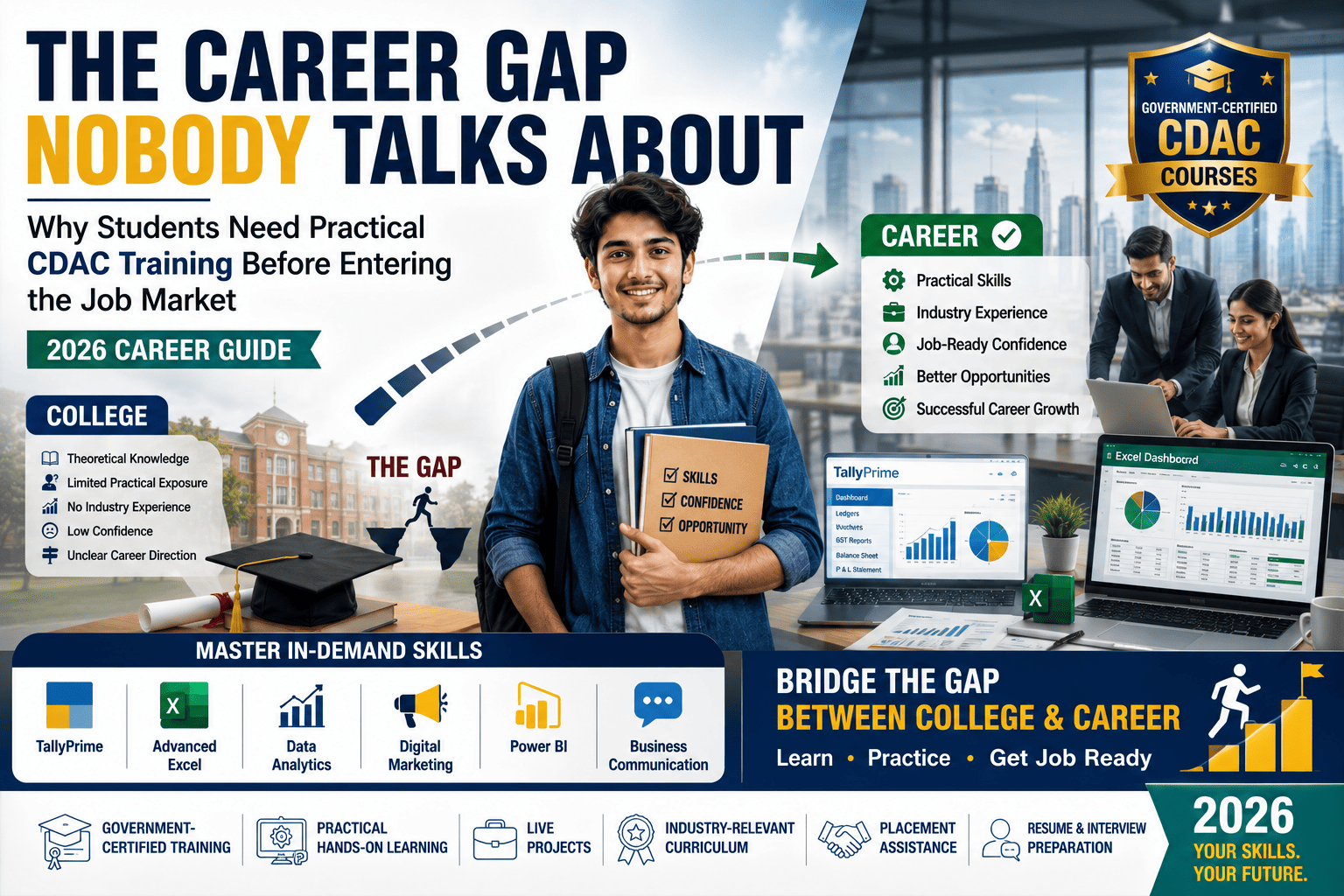
Every year, thousands of students graduate with degrees and high academic scores, yet many struggle to secure their first job. The reason is a growing career gap—the difference between what students learn in college and the practical skills employers expect in the workplace.
Today’s organisations are looking for candidates who can contribute from day one. They value hands-on experience with business software, data analysis, communication, problem-solving, and digital tools alongside academic qualifications.
Government-Certified CDAC training helps bridge this gap by providing practical, industry-oriented education in areas such as TallyPrime, Advanced Excel, Digital Marketing, Data Analytics, Full Stack Development, Graphic Design, Spoken English, and more. This guide explores why practical CDAC training has become one of the smartest career investments for students preparing to enter the job market in 2026.
Understanding the Career Gap
Many students believe that completing a college degree is enough to start a successful career. However, employers often identify a mismatch between academic learning and workplace requirements.
This “career gap” includes:
- Limited practical experience
- Lack of software knowledge
- Poor workplace communication
- Limited problem-solving skills
- Little exposure to business processes
- Low confidence during interviews
- No experience with live projects
Bridging this gap before graduation significantly improves employability.
Why Employers Prioritise Practical Skills in 2026
Businesses want employees who can quickly adapt to modern workplaces.
Recruiters increasingly seek candidates who can:
- Work with industry-standard software
- Analyse and manage business data
- Prepare professional reports
- Communicate effectively
- Understand business operations
- Learn new technologies quickly
- Work collaboratively in teams
Students with practical certifications and software skills often stand out during recruitment.
What Are Government-Certified CDAC Courses?
Government-Certified CDAC courses are career-oriented training programmes that focus on developing practical, job-ready skills. Rather than relying only on theoretical instruction, these programmes combine classroom learning with hands-on projects, software training, and professional development.
Depending on the institute and programme, students may receive government-recognised or industry-recognised certifications after successful completion.
How CDAC Training Bridges the Career Gap
1. Practical Learning with Industry Tools
Students learn by working on software commonly used in businesses, including:
- TallyPrime
- Advanced Excel
- Power BI
- Digital Marketing Tools
- Graphic Design Software
- Web Development Technologies
This practical exposure helps students understand real workplace tasks.
2. Industry-Relevant Curriculum
CDAC programmes are designed around current industry requirements rather than outdated theoretical concepts.
Students develop skills that employers actively seek.
3. Real Projects and Assignments
Instead of memorising concepts, learners gain experience through:
- Practical assignments
- Case studies
- Live projects
- Simulated business scenarios
This builds confidence and problem-solving abilities.
4. Professional Development
Many CDAC institutes also provide training in:
- Resume Writing
- Interview Preparation
- Business Communication
- Presentation Skills
- Workplace Etiquette
- Career Counselling
These soft skills are essential for professional success.
Why TallyPrime and Advanced Excel Matter
Two of the most valuable workplace skills remain TallyPrime and Advanced Excel.
TallyPrime Skills
Students learn:
- GST Accounting
- Voucher Entry
- Inventory Management
- Payroll
- Banking
- Financial Reports
- Balance Sheets
- Profit & Loss Statements
These skills are highly relevant for accounting, finance, and business administration roles.
Advanced Excel Skills
Students gain expertise in:
- IF Functions
- VLOOKUP & XLOOKUP
- Pivot Tables
- Power Query
- Dashboards
- Charts
- Data Cleaning
- MIS Reporting
- Business Analysis
Advanced Excel is used across finance, HR, operations, sales, administration, and analytics.
Beyond Technical Skills: Building Workplace Confidence
Practical training also develops:
- Communication Skills
- Time Management
- Teamwork
- Leadership
- Critical Thinking
- Adaptability
- Professional Behaviour
These competencies help students transition smoothly into professional environments.
Career Opportunities After Practical CDAC Training
Depending on the course, students can pursue roles such as:
- Accounts Executive
- GST Executive
- MIS Executive
- Finance Executive
- Digital Marketing Executive
- Data Analyst
- Graphic Designer
- UI/UX Designer
- Full Stack Developer
- Office Administrator
- Payroll Executive
- Business Support Executive
- Customer Relationship Executive
Industries Hiring Practical Skill Professionals
Graduates with practical CDAC training are sought after in:
- Information Technology
- Accounting & Finance
- Banking
- Manufacturing
- Healthcare
- Retail
- Logistics
- Education
- Digital Marketing Agencies
- Startups
- E-commerce
- Consulting Firms
Benefits of Government-Certified CDAC Training
Students gain:
- Industry-recognised certification
- Practical software knowledge
- Better interview preparation
- Improved resume
- Stronger workplace confidence
- Placement assistance (where offered)
- Career guidance
- Enhanced employability
While certification does not guarantee employment, it demonstrates commitment to professional development and practical learning.
Who Should Enrol in CDAC Courses?
These programmes are suitable for:
Students
- 12th Pass Students
- Diploma Students
- Undergraduate Students
- Postgraduate Students
Graduates
- B.Com
- BBA
- MBA
- BCA
- MCA
- B.Sc.
- Engineering
- Arts Graduates
Professionals
- Job Seekers
- Career Changers
- Working Professionals
- Entrepreneurs
Why Ahmedabad Is a Great Place for Practical Career Training
Ahmedabad has become one of Gujarat’s leading education and employment hubs.
Students benefit from:
- Growing corporate sector
- Expanding startup ecosystem
- Affordable education
- Career-focused institutes
- Internship opportunities
- Industry exposure
- Placement support
This makes Ahmedabad an excellent destination for practical skill development.
Future Scope After CDAC Training
Practical skills provide a foundation for advanced career pathways such as:
- Power BI
- Data Analytics
- SAP
- ERP Systems
- Financial Modelling
- Business Intelligence
- AI-Powered Analytics
- Tax Consultancy
- Financial Planning
Continuous upskilling helps professionals remain competitive in the evolving digital economy.
Frequently Asked Questions (FAQs)
1. What is the career gap?
The career gap refers to the difference between academic knowledge gained in college and the practical skills employers expect from job candidates.
2. Why is practical CDAC training important?
It helps students develop real-world software, technical, and professional skills that improve employability and workplace readiness.
3. Are Government-Certified CDAC courses useful?
Yes. They provide structured practical training and recognised certifications that can strengthen a student’s profile.
4. Which practical skills are most important in 2026?
Highly valued skills include TallyPrime, Advanced Excel, Data Analytics, Digital Marketing, Power BI, communication, and problem-solving.
5. Can students from non-commerce backgrounds join CDAC courses?
Yes. Many programmes are designed for students from commerce, science, arts, engineering, management, and other academic disciplines.
6. Do CDAC institutes provide placement assistance?
Many institutes offer resume building, interview preparation, and placement support. Students should verify the services provided by their chosen institute.
7. How do practical skills improve job opportunities?
Practical skills help students perform workplace tasks more efficiently, build confidence, and meet employer expectations, increasing their competitiveness in the job market.
Conclusion
The biggest challenge many graduates face today is not a lack of education—it is a lack of practical, workplace-ready skills. This career gap can delay employment and make the transition from college to the workplace more difficult.
Government-Certified CDAC training helps students bridge this gap by combining industry-focused learning, practical software training, professional development, and recognised certification. Whether you aspire to build a career in accounting, finance, digital marketing, data analytics, design, or technology, investing in practical skills before entering the job market can make a meaningful difference to your confidence, employability, and long-term career growth in 2026.