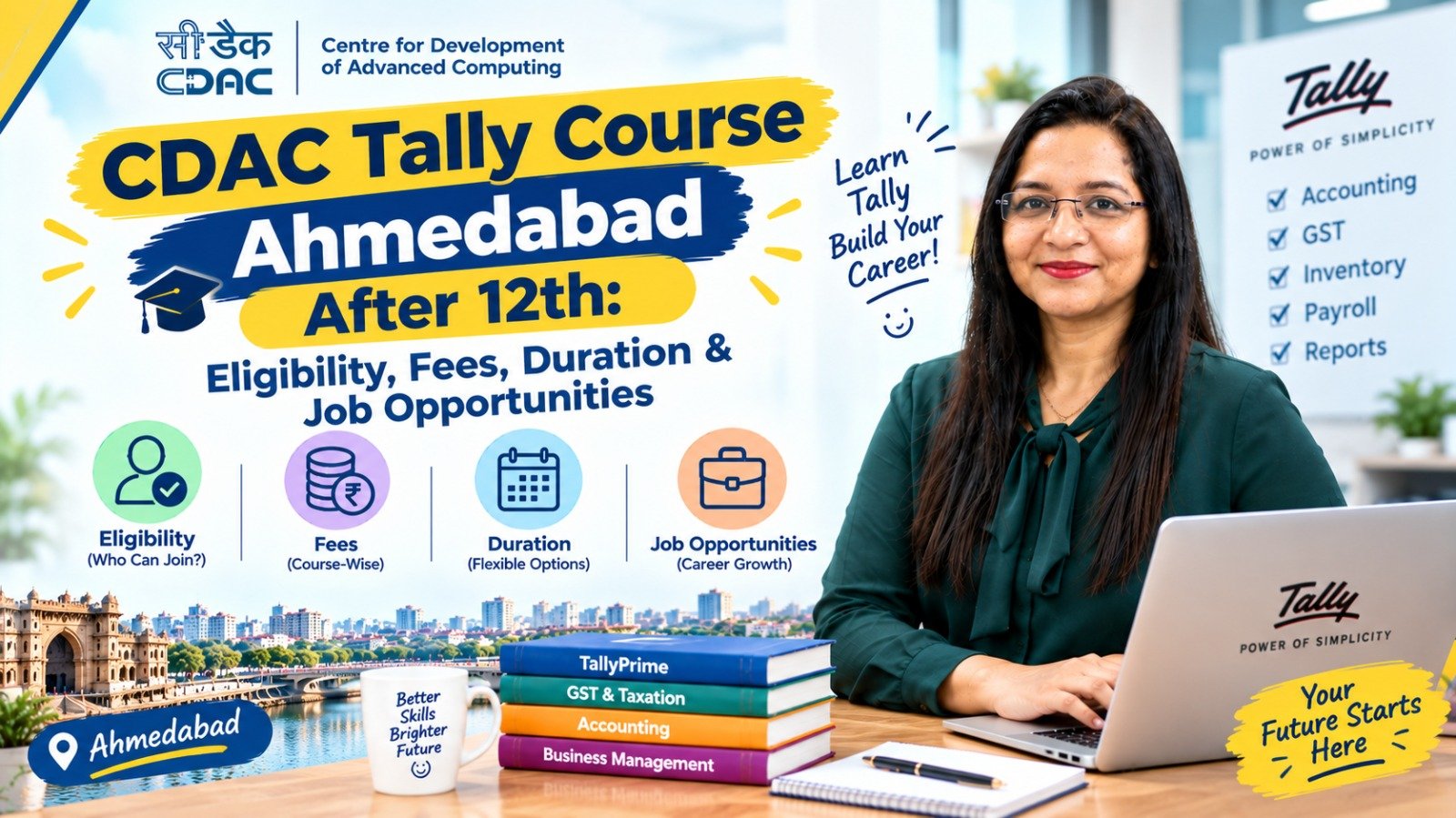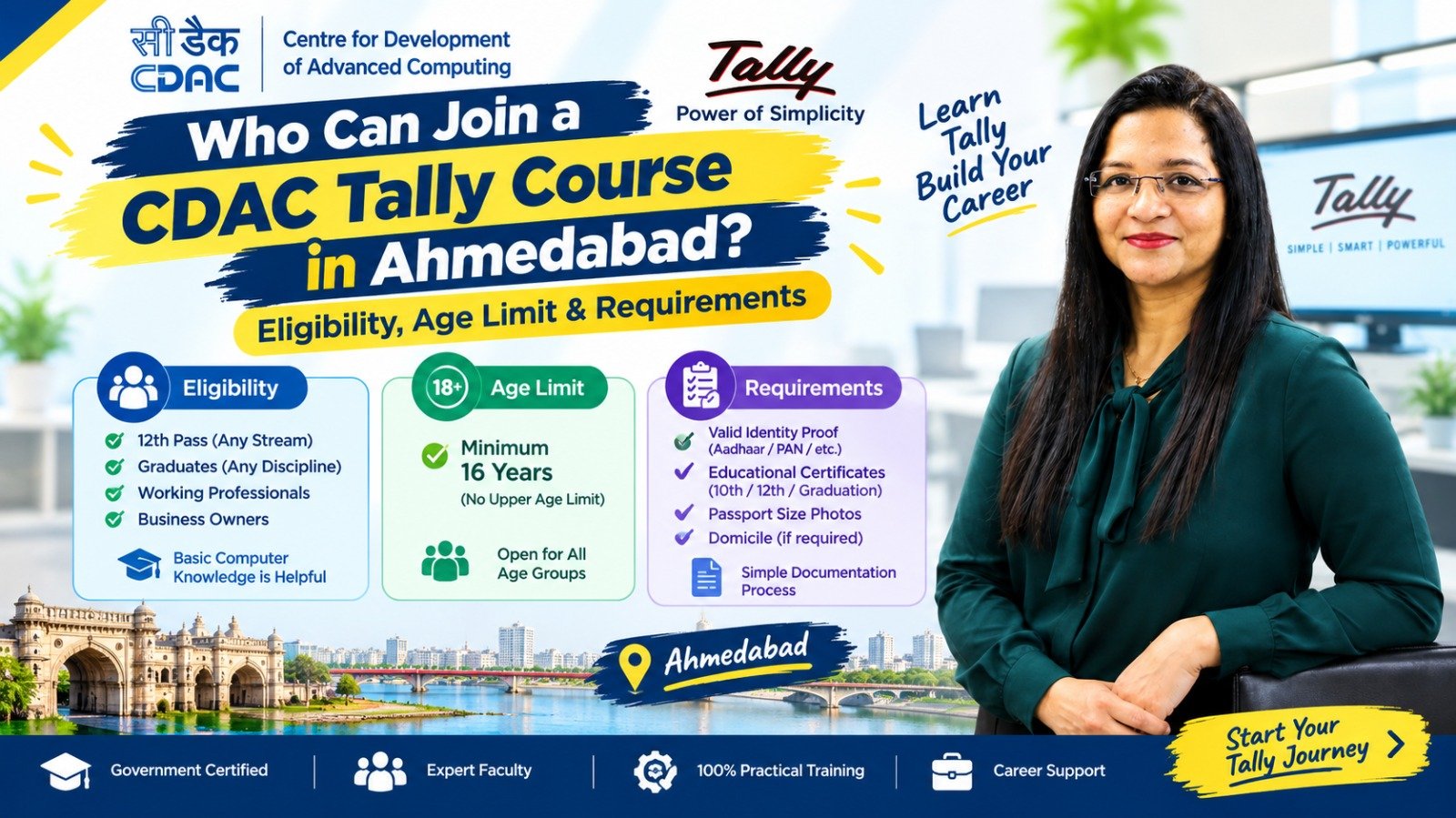
A Tally course can be useful for students, job seekers, graduates and working professionals who want to develop accounting and business software skills. However, eligibility requirements can vary depending on the specific institute and programme.
This guide explains who can generally join a Tally course in Ahmedabad, whether 10th or 12th qualification is required, age-limit considerations, eligibility for commerce and non-commerce students, requirements for working professionals and important points to verify when a course is advertised as a “CDAC Tally Course.”
Introduction
Tally is widely used for accounting, invoicing, taxation, inventory management and business record keeping. Because of its practical applications, many students and job seekers in Ahmedabad search for Tally courses to improve their employability.
A common search query is:
“Who can join a CDAC Tally course in Ahmedabad?”
Students may also search for:
- CDAC Tally course eligibility
- Tally course after 12th
- Tally course age limit
- Tally course eligibility for graduates
- Tally course for non-commerce students
- TallyPrime course in Ahmedabad
Before joining any course, however, it is important to distinguish between a general Tally course offered by a training institute and a specific programme that is officially affiliated with C-DAC (Centre for Development of Advanced Computing).
The eligibility criteria, certification and admission requirements can differ between programmes.
Who Can Join a Tally Course in Ahmedabad?
In general, Tally courses can be suitable for a broad range of learners.
Depending on the institute and course level, eligible learners may include:
- 10th-pass students
- 12th-pass students
- Commerce students
- Arts students
- Science students
- College students
- Graduates
- Job seekers
- Accountants
- Business owners
- Working professionals
- People changing careers
The exact minimum qualification depends on the individual course.
Can I Join a Tally Course After 10th?
Some beginner-level Tally courses may accept students after 10th standard.
These courses generally start with basic concepts such as:
- Computer fundamentals
- Accounting basics
- Debit and credit
- Ledger
- Journal entries
- Sales and purchases
- Invoicing
- Basic TallyPrime operations
However, students should check the individual institute’s admission requirements before registering.
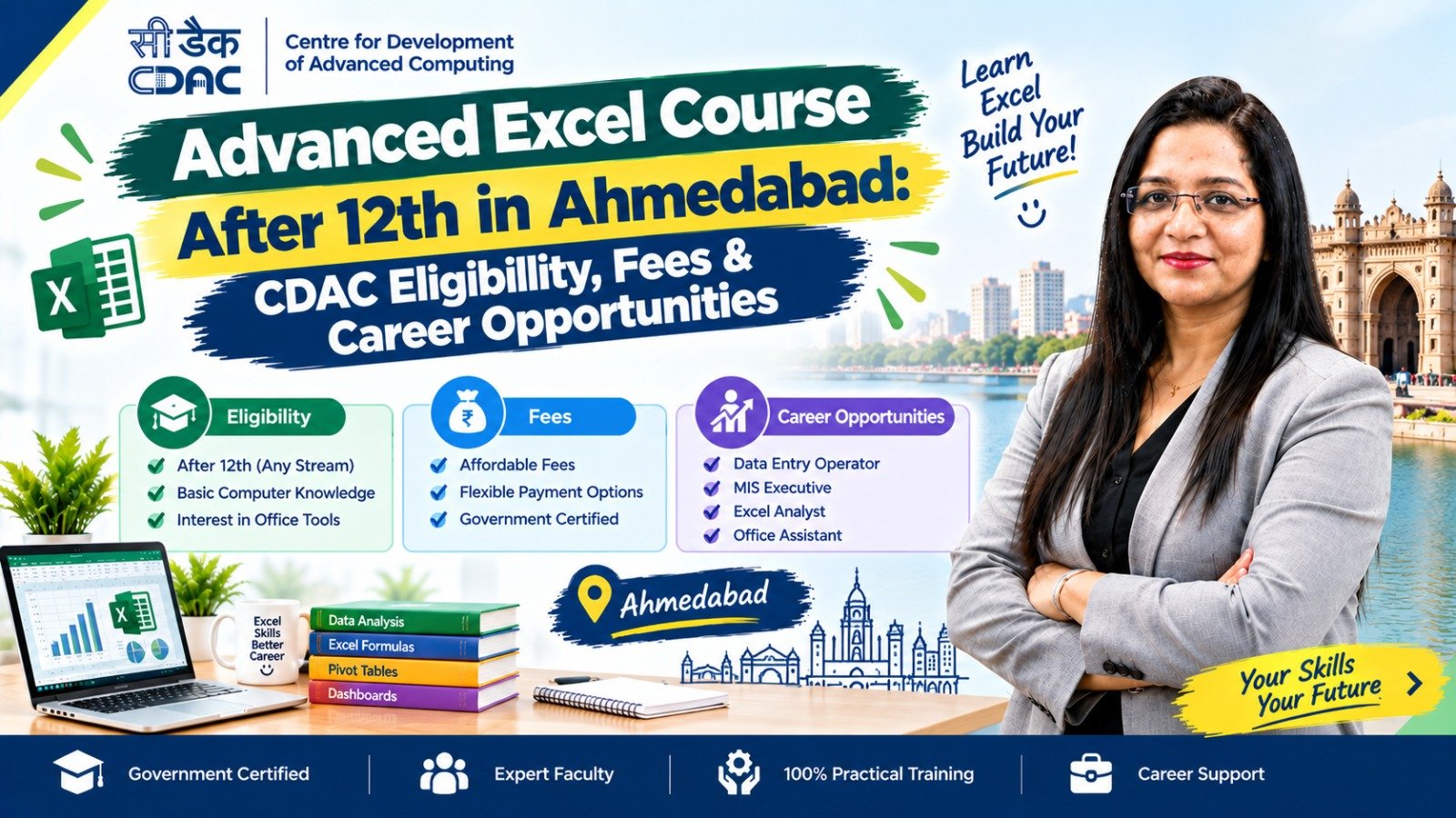
Can I Join a Tally Course After 12th?
Yes, 12th-pass students can generally consider beginner-level Tally courses, subject to the specific institute’s eligibility criteria.
Commerce students may already have some knowledge of:
- Accounting
- Journal entries
- Ledger
- Trial balance
- Profit and loss
- Balance sheet
Students from science or arts backgrounds can also learn Tally. They may simply need additional time to understand basic accounting concepts.
A beginner-friendly pathway can be:
Basic Accounting → TallyPrime → GST → Advanced Excel → Practical Projects
Can Commerce Students Join a CDAC Tally Course?
Commerce students are often interested in Tally because it complements accounting education.
A commerce student may learn:
- Accounting fundamentals
- TallyPrime
- GST
- Inventory
- Payroll
- Banking
- Financial reports
- Advanced Excel
This combination can provide practical software skills alongside academic accounting knowledge.
Can Non-Commerce Students Join a Tally Course?
Yes, depending on the course’s admission requirements.
Students from:
- Arts
- Science
- Humanities
- Other educational backgrounds
can learn Tally if they are willing to understand accounting fundamentals.
For a complete beginner, the recommended order is:
Step 1
Learn basic accounting terminology.
Step 2
Understand debit and credit.
Step 3
Learn journal and ledger concepts.
Step 4
Start TallyPrime.
Step 5
Learn GST and taxation-related workflows.
Step 6
Practise real-world accounting transactions.
This foundation can make Tally easier to understand.
Is There an Age Limit for a Tally Course?
For general private Tally training, the age requirement can vary by institute.
Many beginner-oriented professional courses are open to adult learners across different age groups, but students should confirm the specific provider’s rules.
There should not be an assumption that every programme has the same age criteria.
If you are specifically asking about a CDAC programme, check the eligibility conditions of that exact programme because C-DAC programmes can have programme-specific requirements.
Can Working Professionals Join a Tally Course?
Yes, many working professionals learn Tally to improve their accounting or business skills.
A working professional may want to learn Tally for:
- Career development
- Changing job roles
- Accounting responsibilities
- Business management
- Invoicing
- GST-related work
- Inventory management
Working professionals can consider:
- Evening classes
- Weekend classes
- Online classes
- Short-term courses
The availability of these options depends on the institute.
Can Business Owners Learn Tally?
Yes.
Business owners may use Tally-related skills to understand:
- Sales
- Purchases
- Expenses
- Receivables
- Payables
- Inventory
- GST-related records
- Financial reports
However, businesses should use appropriate professional accounting and tax advice for compliance-related decisions.
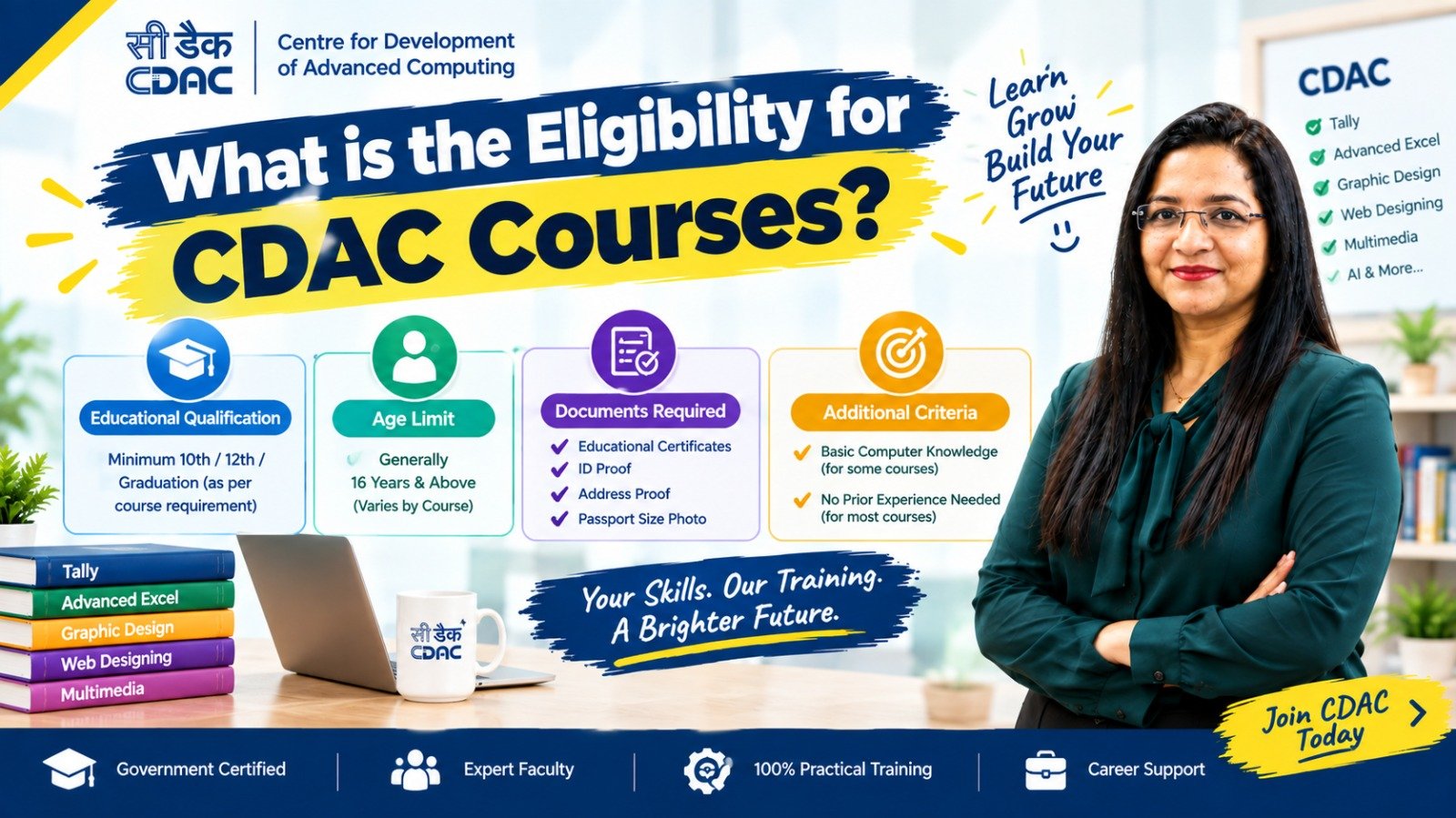
What Are the Basic Requirements for Joining a Tally Course?
For a beginner-level course, the requirements may be relatively simple.
Educational Requirement
Depending on the institute, eligibility may start from:
- 10th pass
- 12th pass
- Graduation
Some advanced programmes may have additional requirements.
Computer Knowledge
Basic computer knowledge can be helpful.
Students should ideally know how to:
- Use a keyboard
- Use a mouse
- Open applications
- Create and save files
- Manage folders
Accounting Knowledge
For beginner courses, previous accounting knowledge may not always be required.
However, understanding basic accounting concepts can make the course easier.
What Is a CDAC Tally Course?
The term CDAC Tally course needs to be understood carefully.
C-DAC stands for Centre for Development of Advanced Computing, a national organisation under the Ministry of Electronics and Information Technology.
Not every Tally course advertised using the term “CDAC” is automatically an official C-DAC programme.
Therefore, before admission, ask the training provider:
- What is the exact programme name?
- Is this an official C-DAC programme?
- What organisation issues the certificate?
- Can the affiliation be verified?
- What are the exact eligibility requirements?
- Is the certification included in the fee?
This is particularly important if you are choosing a course because you expect an official C-DAC certificate.
CDAC Tally Course Eligibility in Ahmedabad
Eligibility depends on the specific programme and institute.
Before enrolling, check whether the course requires:
- Minimum educational qualification
- Specific academic background
- Computer knowledge
- Accounting knowledge
- Entrance test
- Age criteria
- Identity documents
- Previous certification
Do not assume that a Tally course advertised as “CDAC” has the same eligibility requirements as another CDAC-labelled course.
Tally Course Requirements: Documents
Training institutes may ask students to provide documents during admission.
Depending on the institute, these may include:
- Identity proof
- Passport-size photographs
- Educational qualification documents
- 10th certificate
- 12th certificate
- Graduation documents, if applicable
- Address proof
The exact documentation requirements vary by provider.
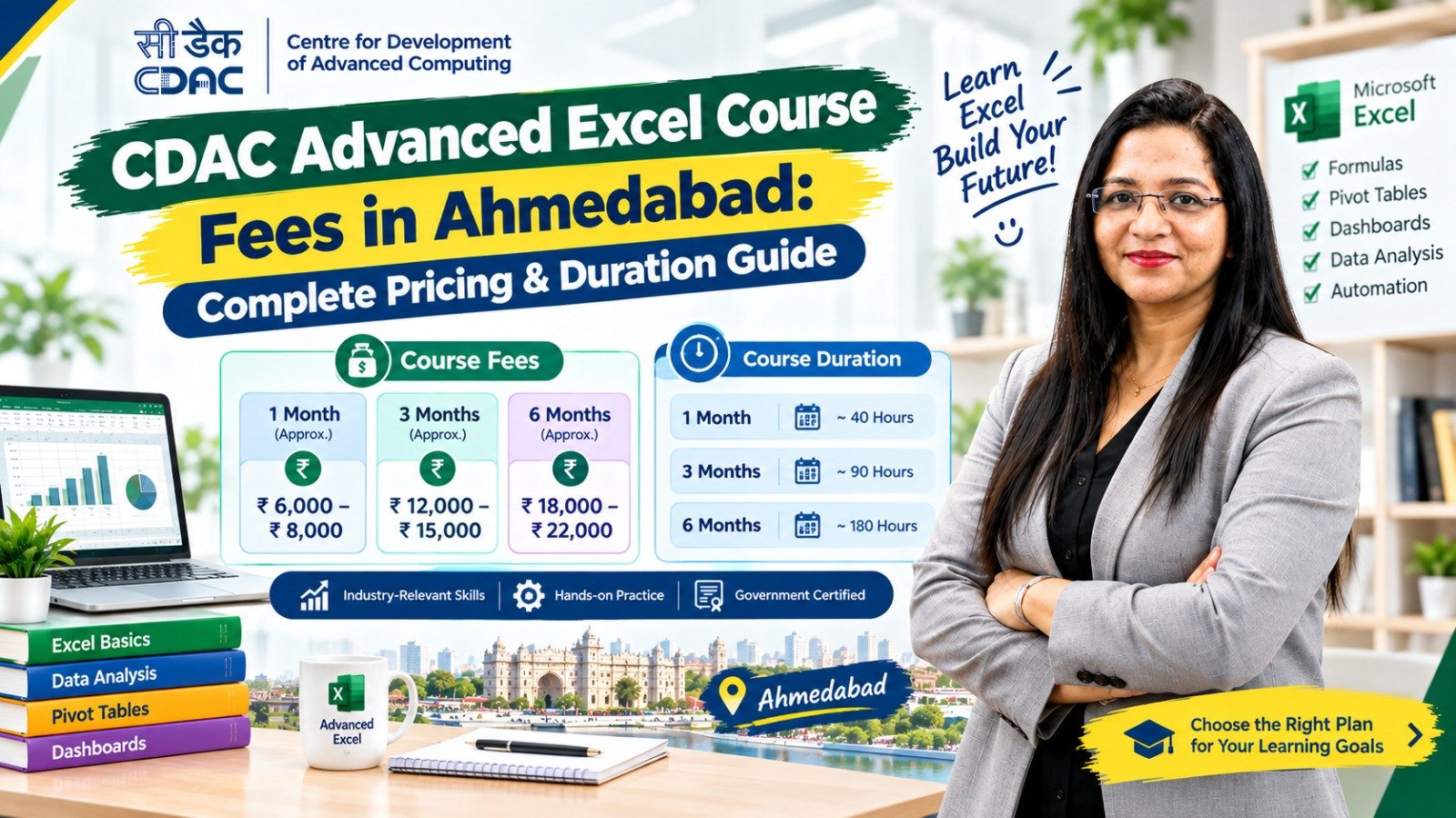
Tally Course Duration in Ahmedabad
Tally course duration depends on the syllabus.
A general structure may look like:
| Course Type | Approximate Duration |
|---|---|
| Basic Tally | 1–2 months |
| Tally + GST | 2–3 months |
| Advanced Tally & Accounting | 3–6 months |
| Tally + Advanced Excel | 3–6 months |
| Comprehensive Accounting Course | 4–12 months |
These are general ranges, not fixed Ahmedabad standards.
Always ask the institute for the exact number of classes and training hours.
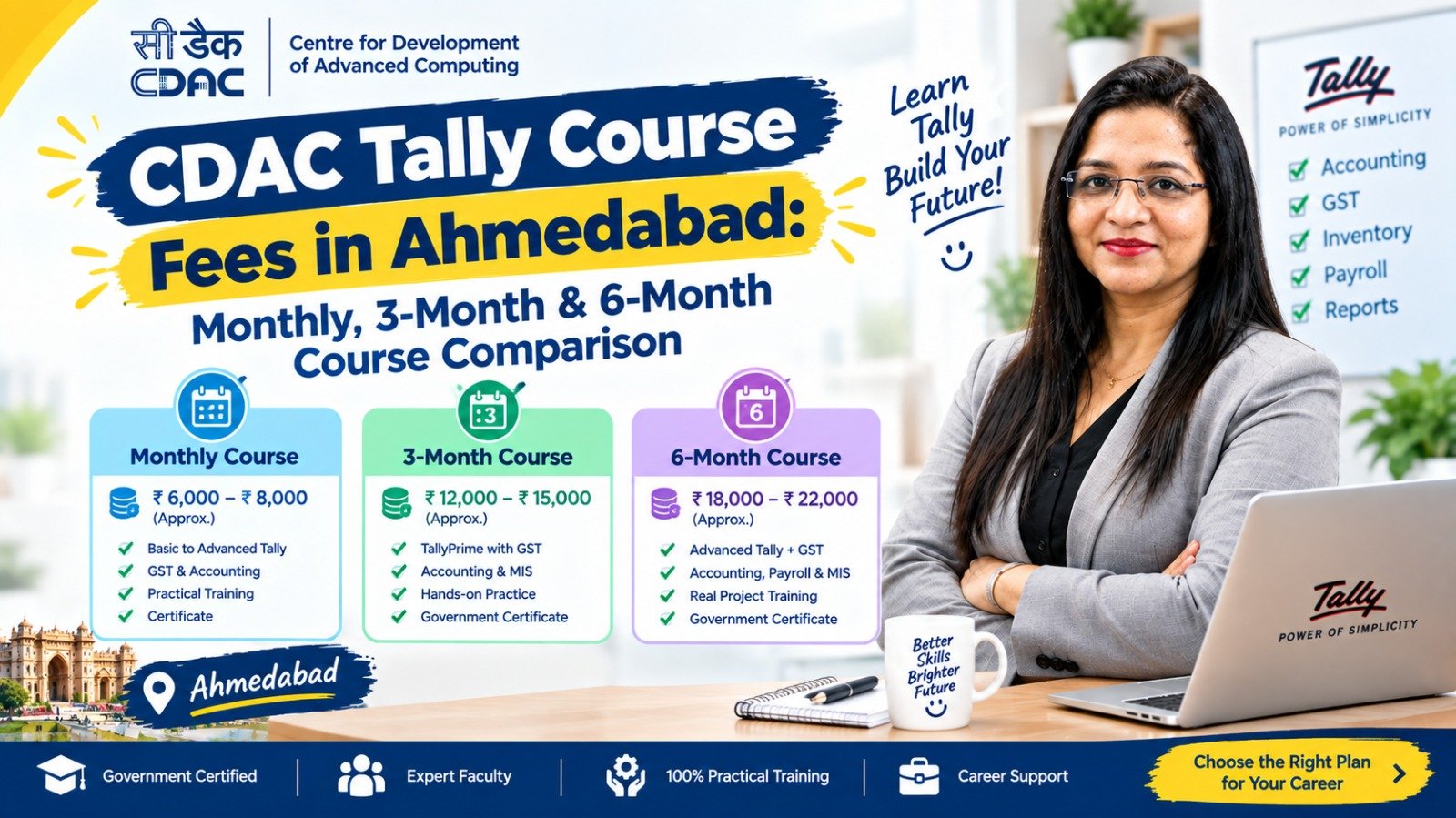
Tally Course Fees in Ahmedabad
Fees vary depending on:
- Course duration
- Syllabus
- Training format
- Practical training
- Certification
- Trainer
- Study materials
- GST module
- Advanced Excel
- Payroll
- Inventory
- Career support
Instead of asking only:
“What is the Tally course fee?”
ask:
“What is the complete fee, and what modules and services are included?”
This gives you a clearer basis for comparison.
What Will You Learn in a Tally Course?
A practical Tally course may include the following.
1. Accounting Fundamentals
- Accounting concepts
- Debit and credit
- Journal
- Ledger
- Trial balance
- Profit and loss
- Balance sheet
2. TallyPrime Basics
- Company creation
- Company configuration
- Groups
- Ledgers
- Voucher types
3. Voucher Entries
- Payment
- Receipt
- Contra
- Purchase
- Sales
- Journal
- Debit note
- Credit note
4. GST
Depending on the course syllabus:
- GST basics
- GST configuration
- GST transactions
- Tax invoices
- GST reports
5. Inventory
- Stock groups
- Stock items
- Units
- Godowns
- Purchase and sales inventory
6. Banking
- Bank ledgers
- Bank reconciliation
- Payment and receipt records
7. Payroll
Some advanced courses may cover:
- Employee records
- Salary structures
- Attendance
- Payroll reports
8. Financial Reports
Students may work with:
- Trial balance
- Profit and loss account
- Balance sheet
- Outstanding reports
- Stock reports
Career Opportunities After Tally
Tally skills can support entry-level roles such as:
- Junior Accountant
- Accounts Assistant
- Accounting Executive
- Billing Executive
- Tally Operator
- Finance Assistant
- Accounts Data Entry Operator
- GST Assistant
- Inventory Executive
- Back Office Executive
Actual job requirements vary by employer.
Tally certification alone does not guarantee employment. Employers may also look for accounting knowledge, Excel skills, GST knowledge, communication ability and practical experience.
Tally + Advanced Excel: A Useful Combination
Students interested in accounting can consider learning both Tally and Advanced Excel.
Tally helps with:
- Accounting records
- Transactions
- GST workflows
- Inventory
- Financial reports
Excel helps with:
- Data analysis
- Calculations
- Reporting
- MIS
- Data organisation
- Business dashboards
Together, they can provide a broader practical skill set.
A possible learning path is:
Accounting Basics → TallyPrime → GST → Advanced Excel → Practical Accounting Projects
Is Tally Suitable for Students After 12th?
Tally can be a practical additional skill after 12th, especially for students interested in accounting, finance, office administration or business.
Commerce students may find the accounting concepts familiar, but students from other streams can also learn Tally by starting with accounting fundamentals.
Students should consider Tally as a skill-building course, not necessarily a replacement for a degree or professional accounting qualification.
How to Choose a Tally Course in Ahmedabad
Before admission, compare these points:
1. Eligibility
Confirm that your educational qualification meets the course requirements.
2. Syllabus
Ask for a complete module-wise syllabus.
3. Practical Training
Find out whether you will practise actual accounting transactions.
4. Course Duration
Ask for the total number of classes and training hours.
5. Trainer
Check the trainer’s accounting and Tally experience.
6. Certification
Ask who issues the certificate.
7. CDAC Affiliation
If the course is advertised as CDAC, verify the exact affiliation.
8. Fees
Ask about all additional charges.
9. Batch Timing
Students can compare morning, evening, weekend and online options where available.
10. Career Support
Ask exactly what placement or career assistance includes.
CDAC Tally Course Eligibility: Quick Guide
| Student/Professional | Can They Consider Tally? | What to Check |
|---|---|---|
| 10th Pass | Often suitable for beginner courses | Institute eligibility |
| 12th Pass | Generally suitable for beginner courses | Exact programme requirements |
| Commerce Student | Suitable | Accounting level |
| Science Student | Can learn | May need accounting basics |
| Arts Student | Can learn | May need accounting basics |
| Graduate | Suitable | Course level |
| Working Professional | Often suitable | Timings and format |
| Business Owner | Suitable for skill development | Business requirements |
| Career Changer | Can learn | Beginner syllabus |
The table is a general guide. The actual eligibility criteria are determined by the specific programme provider.
Frequently Asked Questions
1. Who can join a CDAC Tally course in Ahmedabad?
Eligibility depends on the specific programme. General beginner-level Tally courses may accept 10th- or 12th-pass students, graduates and working professionals, but students should verify the exact requirements of the programme they are considering.
2. Is there an age limit for a Tally course?
Age requirements vary by institute and programme. General private Tally courses may be open to learners across different age groups, while specific programmes can have their own eligibility rules.
3. Can I join Tally after 12th?
Yes. Many beginner-level Tally courses are suitable for 12th-pass students, subject to the institute’s admission requirements.
4. Can a non-commerce student learn Tally?
Yes. Students from science, arts and other backgrounds can learn Tally. Beginners may benefit from first learning basic accounting concepts.
5. Is a graduation degree required for Tally?
Not necessarily for many beginner-level Tally courses. However, requirements can differ for advanced or specialised programmes.
6. Do I need accounting knowledge before learning Tally?
Not always. A beginner course can teach accounting fundamentals first. However, having basic accounting knowledge can make learning Tally easier.
7. Can working professionals join a Tally course?
Yes. Depending on the institute, working professionals may be able to choose evening, weekend or online classes.
8. What is the duration of a Tally course in Ahmedabad?
The duration varies. Basic courses may take around 1–2 months, while Tally + GST or advanced accounting programmes can take several months.
9. What is the fee for a Tally course in Ahmedabad?
Fees vary according to the syllabus, duration, training format, certification and practical training. Students should compare the complete course package.
10. Is every course called “CDAC Tally” an official C-DAC course?
No. Students should verify the exact programme, affiliation and certificate issuer before assuming that a course is officially affiliated with C-DAC.
11. What jobs can I get after a Tally course?
Possible entry-level roles include Junior Accountant, Accounts Assistant, Billing Executive, Tally Operator, Finance Assistant, GST Assistant and Inventory Executive. Actual requirements vary by employer.
12. Should I learn Advanced Excel with Tally?
For accounting and office-related roles, combining Tally with Advanced Excel can provide useful complementary skills in accounting, reporting and data management.
Conclusion
A CDAC Tally course in Ahmedabad can be relevant to students, job seekers, graduates and working professionals who want to develop accounting software skills. However, eligibility, age requirements, course duration and certification depend on the specific programme and training provider.
Students after 12th can generally explore beginner-level Tally courses, while commerce and non-commerce students can both learn Tally with the appropriate foundation.
Before enrolling, carefully compare the eligibility, syllabus, duration, practical training, fees, certification and career support. If a course is advertised as a CDAC or government-certified programme, verify the exact affiliation and certificate issuer rather than relying only on the course name.
For a broader accounting skill set, a practical pathway can be:
Accounting Fundamentals → TallyPrime → GST → Advanced Excel → Practical Projects
This approach can help learners develop skills that are relevant to accounting, finance, billing, MIS and business-support roles.