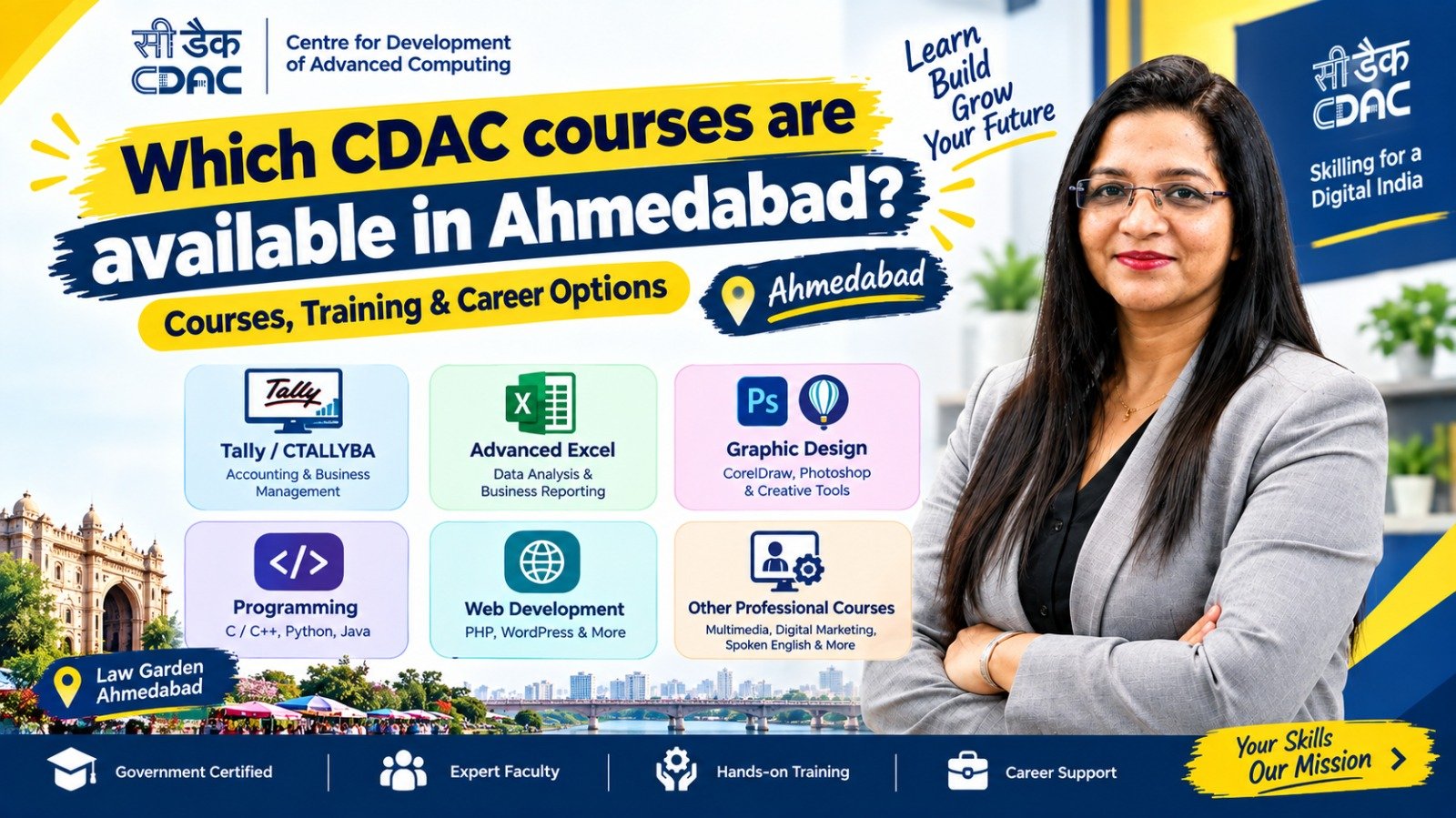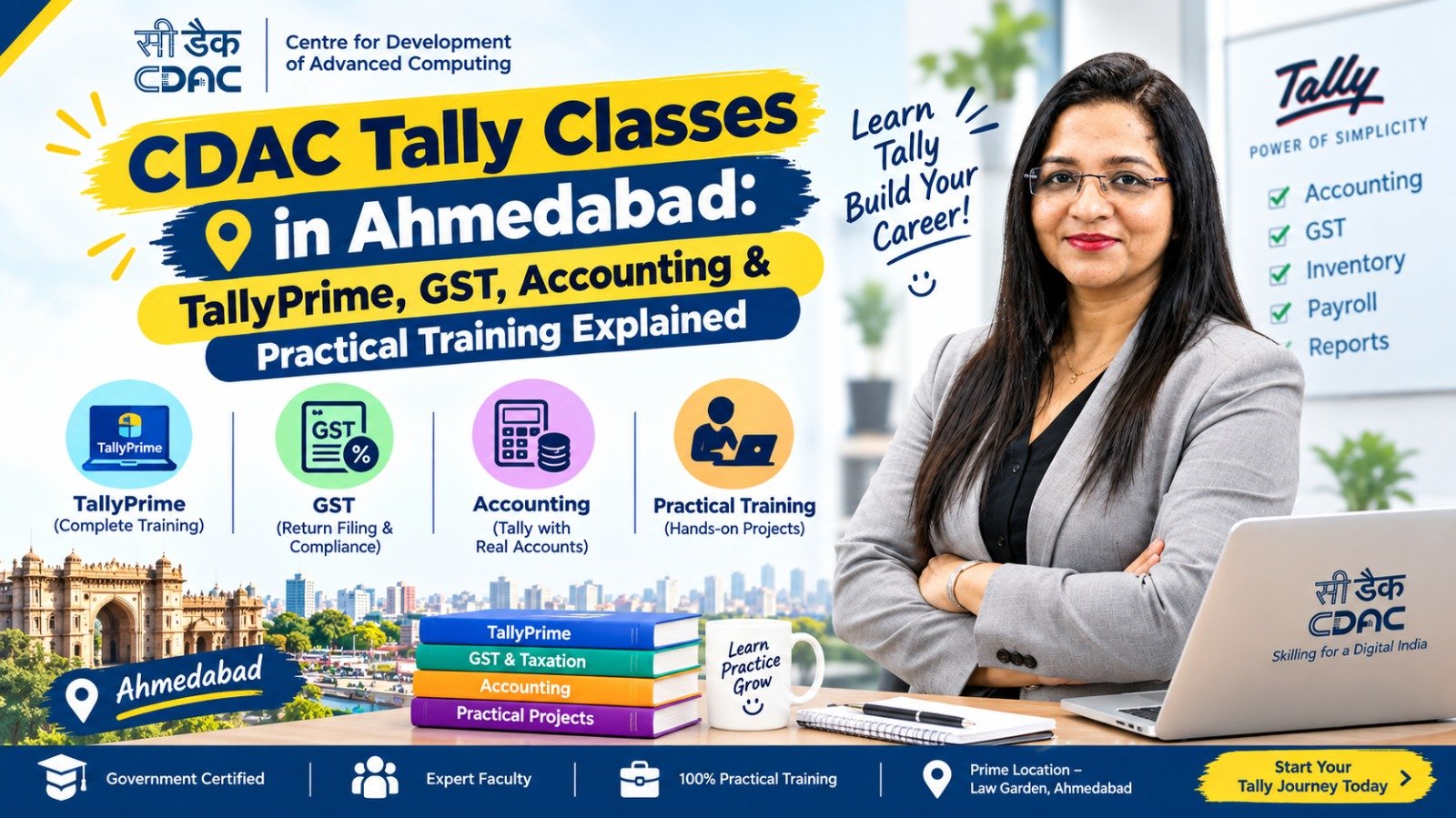
Learning accounting software through practical training can help students and job seekers develop workplace-ready skills. CDAC Tally classes in Ahmedabad are often searched by learners who want to study TallyPrime, GST, accounting fundamentals and practical business transactions in one programme.
However, students should understand what the term “CDAC Tally” actually means before enrolling. CDAC and Tally are separate concepts, and not every private institute advertising a “CDAC Tally course” necessarily offers an official CDAC programme.
This guide explains what students should expect from Tally classes, including TallyPrime, GST, accounting, inventory, banking, Excel, practical projects, course duration, fees, certification and career opportunities.
Introduction
Accounting is an essential function for almost every business. From recording purchases and sales to managing payments, GST transactions, inventory and financial reports, businesses need people who understand both accounting concepts and accounting software.
TallyPrime is one of the software platforms learners may study to build practical accounting and business-management skills.
For students and job seekers in Ahmedabad, Tally classes can be useful for developing skills related to:
- Accounting
- Billing
- GST
- Inventory
- Banking
- Financial reports
- Business transactions
- Excel and data management
But before joining a course advertised as “CDAC Tally classes,” it is important to understand the certification and affiliation details.
What Are CDAC Tally Classes?
CDAC stands for Centre for Development of Advanced Computing, an organisation under the Ministry of Electronics and Information Technology (MeitY), Government of India.
CDAC conducts education and training programmes in several technology-related areas.
TallyPrime, meanwhile, is accounting and business-management software used for activities such as accounting, invoicing, inventory and taxation-related workflows.
Therefore, the phrase “CDAC Tally classes” may be used by training providers in different ways.
If an Ahmedabad institute claims that its Tally programme is associated with CDAC, students should verify:
- Exact programme name
- CDAC affiliation or authorisation
- Training provider details
- Certificate issuer
- Certification name
- Whether the certificate is officially verifiable
- Whether certification is included in the course fee
Do not assume that a course is an official CDAC programme merely because the word CDAC appears in its advertisement.
What Do Tally Classes in Ahmedabad Usually Teach?
A well-structured Tally accounting programme generally combines accounting concepts with software practice.
The syllabus may include:
- Accounting fundamentals
- TallyPrime basics
- Company creation
- Groups and ledgers
- Voucher entries
- Sales and purchases
- GST
- Inventory
- Banking
- Payroll
- Financial reports
- Practical projects
- Excel
- Business documentation
The exact syllabus varies between institutes.
1. Accounting Fundamentals
Learning Tally without understanding accounting can make it difficult to understand why transactions are recorded in a particular way.
Therefore, practical Tally training should ideally begin with basic accounting concepts.
Important topics include:
- Assets
- Liabilities
- Capital
- Revenue
- Expenses
- Debit and credit
- Journal
- Ledger
- Trial balance
- Profit and loss
- Balance sheet
These concepts create the foundation for working with accounting software.
2. TallyPrime Training
TallyPrime training generally introduces students to the software and its accounting workflow.
Students may learn:
- TallyPrime interface
- Company creation
- Company configuration
- Company features
- Security settings
- Ledger creation
- Groups
- Voucher entry
- Reports
- Data management
The goal should be to move beyond simply learning menu locations and understand how the software is used in actual business transactions.
3. Ledger and Group Creation
Ledger management is a fundamental part of accounting software training.
Students can practise creating ledgers for:
- Customers
- Suppliers
- Cash
- Banks
- Purchases
- Sales
- Rent
- Salary
- Electricity
- Office expenses
- Other income
They can also learn how ledgers are organised under appropriate groups.
4. Voucher Entries
Voucher entry is one of the most important practical components of Tally training.
Students may practise:
Payment Voucher
Used for recording payments.
Receipt Voucher
Used for recording money received.
Contra Voucher
Used for certain cash and bank transactions.
Journal Voucher
Used for journal adjustments and other accounting entries.
Sales Voucher
Used for sales transactions.
Purchase Voucher
Used for purchase transactions.
Debit Note
Used for applicable purchase-related adjustments.
Credit Note
Used for applicable sales-related adjustments.
Practical exercises help students understand how everyday business transactions flow through the accounting system.
5. GST Training in TallyPrime
GST is an important part of accounting-related training in India.
A Tally + GST course may introduce students to:
- GST basics
- GST configuration
- GSTIN
- Tax ledgers
- GST sales
- GST purchases
- Input tax concepts
- Taxable transactions
- GST invoices
- GST-related reports
Students should learn GST through practical examples rather than memorising only theoretical definitions.
Because tax rules and procedures can change, learners should also use current official information when dealing with actual business compliance.
6. Inventory Management
TallyPrime can also be used for inventory-related activities.
A practical course may cover:
- Stock groups
- Stock categories
- Stock items
- Units
- Godowns
- Purchase inventory
- Sales inventory
- Stock reports
- Inventory valuation concepts
This can be useful for students who want to work with trading, retail, manufacturing or distribution businesses.
7. Banking and Bank Reconciliation
Accounting professionals frequently work with bank transactions.
Tally training may therefore introduce:
- Bank ledgers
- Bank receipts
- Bank payments
- Cheque transactions
- Bank reconciliation
- Banking-related reports
Practical exercises can help students understand the relationship between accounting records and bank statements.
8. Payroll Accounting
Some advanced Tally courses also introduce payroll.
Depending on the programme, students may learn:
- Employee creation
- Employee groups
- Salary structure
- Attendance
- Payroll processing
- Salary reports
Not every beginner-level Tally course includes detailed payroll, so students should check the syllabus before admission.
9. Financial Reports
Knowing how to generate reports is an important part of accounting software training.
Students may learn to work with:
- Trial Balance
- Profit & Loss Account
- Balance Sheet
- Day Book
- Cash/Bank reports
- Outstanding receivables
- Outstanding payables
- Stock reports
Students should also understand what the reports mean rather than simply learning how to generate them.
Practical Training: Why Does It Matter?
The biggest difference between theoretical learning and practical training is application.
For example, instead of simply learning what a sales voucher is, students can work through a complete transaction:
Customer creation → Sales invoice → GST calculation → Receipt → Outstanding report → Financial report
Similarly, a purchase exercise can follow:
Supplier creation → Purchase entry → GST → Payment → Payable report
These practical workflows can help learners understand how accounting activities are connected.
Example of a Tally Practical Project
A training institute can give students a simulated business project.
For example:
Business: ABC Traders
Students can practise:
Step 1: Create the company
Step 2: Create customer and supplier ledgers
Step 3: Create purchase and sales ledgers
Step 4: Enter opening balances
Step 5: Record purchases
Step 6: Record sales
Step 7: Record GST transactions
Step 8: Record receipts and payments
Step 9: Manage inventory
Step 10: Reconcile bank transactions
Step 11: Generate Trial Balance
Step 12: Generate Profit & Loss Account
Step 13: Generate Balance Sheet
This type of project allows students to practise an end-to-end accounting workflow.
Tally + Advanced Excel
Students interested in accounting careers may also benefit from learning Excel alongside Tally.
TallyPrime can help with:
- Accounting transactions
- Invoicing
- Inventory
- GST-related workflows
- Financial reports
Excel can help with:
- Data management
- Calculations
- Financial analysis
- MIS reports
- Data cleaning
- Sorting and filtering
- Pivot Tables
- Lookup functions
- Reporting
A combination of TallyPrime + GST + Accounting + Excel can provide a broader foundation for entry-level accounting work.
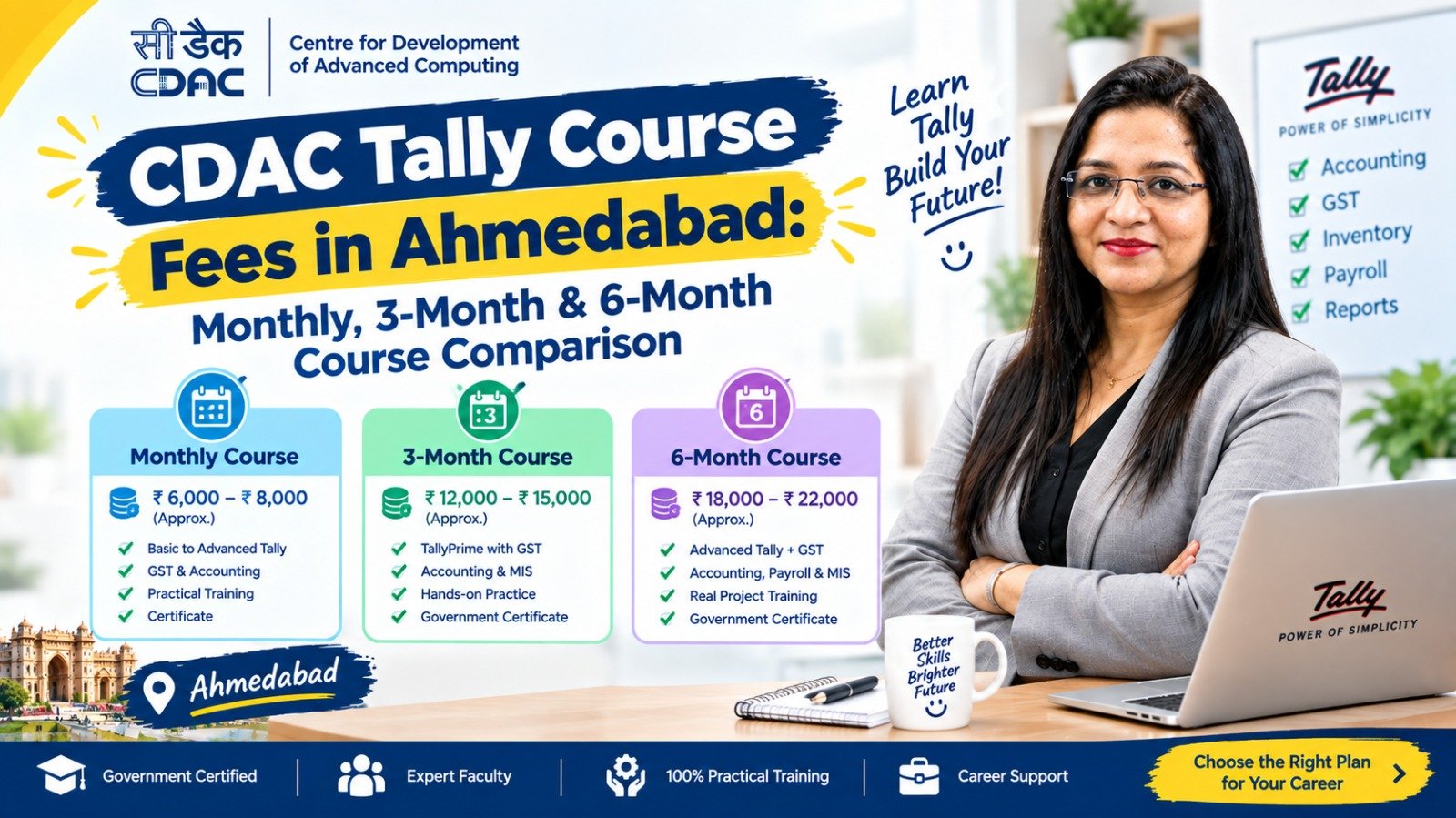
CDAC Tally Classes Fees in Ahmedabad
There is no universal fee for all Tally classes in Ahmedabad.
Course fees can depend on:
| Factor | Effect on Course Fee |
|---|---|
| Course duration | More training hours can increase cost |
| Syllabus | Advanced modules may affect pricing |
| Practical training | Lab/project work can affect fees |
| GST module | May be included in the programme |
| Excel | Some programmes include Excel training |
| Certification | Certificate arrangements can affect cost |
| Study material | Books/digital resources may be included |
| Classroom training | Physical infrastructure can affect pricing |
| Placement support | Career services may be part of the package |
Before paying the fee, ask:
- What is the total fee?
- Are registration charges separate?
- Is GST included?
- Is Excel included?
- Are practical projects included?
- Is the examination fee included?
- Who issues the certificate?
- Are study materials included?
- Is placement assistance included?
Always compare the complete fee structure, not just the advertised starting price.
Tally Course Duration in Ahmedabad
Course duration depends on the level of training.
General examples include:
| Course Level | Approximate Duration |
|---|---|
| Basic TallyPrime | 1–2 months |
| TallyPrime + GST | 2–3 months |
| Advanced Tally + Accounting | 3–6 months |
| Comprehensive Accounting Programme | 4–12 months |
These are general ranges, not a standard CDAC or Ahmedabad-wide duration.
Who Can Join Tally Classes?
Depending on the institute and course level, Tally classes may be suitable for:
- Class 12 students
- Commerce students
- B.Com students
- Graduates
- Job seekers
- Working professionals
- Small-business owners
- Entrepreneurs
- Career changers
Students from a commerce background may already understand basic accounting concepts.
Students from other streams can also learn Tally by first developing basic accounting knowledge.
Tally Classes After 12th
Tally can be learned after Class 12 as a supplementary professional skill.
Commerce Students
12th Commerce → TallyPrime + GST → Excel → Internship/entry-level accounting
Non-Commerce Students
12th → Accounting Fundamentals → TallyPrime → GST + Excel → Practical Project
College Students
Degree → TallyPrime + GST → Advanced Excel → Practical Training → Job/Internship
Tally training can complement a formal degree; it does not necessarily replace one.
Career Opportunities After Tally Training
Students with Tally, accounting and GST skills may apply for entry-level positions such as:
- Junior Accountant
- Accounts Assistant
- Accounting Executive
- Billing Executive
- Tally Operator
- Finance Assistant
- GST Assistant
- Accounts Data Entry Operator
- Inventory Executive
Actual requirements vary by employer.
Employers may also consider:
- Accounting knowledge
- Excel skills
- GST understanding
- Communication skills
- Accuracy
- Computer proficiency
- Previous experience
Completing a Tally course does not guarantee a job.
Tally Classes vs Only Learning Tally Software
There is an important difference between learning software features and learning accounting with software.
Only Software Training
You may learn:
- Where to click
- How to create a ledger
- How to enter a voucher
- How to generate reports
Accounting + Tally Training
You can additionally understand:
- Why a transaction is recorded
- Which ledger should be used
- How debit and credit work
- How GST affects transactions
- How reports are interpreted
- How business transactions connect
For a learner planning an accounting career, understanding both accounting principles and software is valuable.
How to Choose Tally Classes in Ahmedabad
Before admission, compare the following factors.
1. Syllabus
Make sure the programme covers the skills you actually need.
2. Practical Training
Ask how much time is dedicated to hands-on work.
3. TallyPrime
Confirm whether the training is based on the current TallyPrime environment.
4. GST
Check whether GST is taught through practical transactions.
5. Excel
If you want accounting-office skills, ask whether Excel is included.
6. Projects
Ask whether you will complete a full accounting project.
7. Certification
Verify exactly who issues the certificate.
8. Faculty
Ask about trainer experience and teaching methodology.
9. Fees
Get a complete written fee structure.
10. Career Support
Understand whether the institute provides interview preparation, job assistance or internship opportunities.
CDAC Certification: What Should You Verify?
This is especially important when searching for CDAC Tally classes in Ahmedabad.
Before enrolling, ask the institute:
1. Is this an official CDAC programme?
2. What is the exact name of the programme?
3. Is the institute authorised or affiliated with CDAC for this specific programme?
4. Who issues the certificate?
5. Can the certificate be verified?
6. Is the certification fee included in the course fee?
The words “CDAC,” “government certificate” or “government certified” in promotional material should not be treated as proof of official certification without verification.
Admission Guide for Tally Classes in Ahmedabad
The admission process may vary by institute, but students can generally follow this process:
Step 1: Shortlist Courses
Find programmes that match your career goal.
Step 2: Compare Syllabus
Compare TallyPrime, GST, accounting, Excel and practical modules.
Step 3: Check Eligibility
Confirm that you meet the course requirements.
Step 4: Ask About Fees
Request the complete payable amount.
Step 5: Verify Certification
Check the certificate issuer and any claimed CDAC affiliation.
Step 6: Check Batch Timings
Choose a schedule that fits your studies or work.
Step 7: Ask About Practical Training
Confirm whether students get hands-on computer practice.
Step 8: Understand Career Support
Ask what placement assistance actually includes.
Step 9: Complete Admission
Submit the required documents and payment.
Step 10: Begin Training
Start with accounting fundamentals and progressively move toward practical TallyPrime work.
Frequently Asked Questions
1. What are CDAC Tally classes in Ahmedabad?
The term generally refers to Tally/accounting training advertised with a CDAC association. Because CDAC and Tally are distinct, students should verify the exact programme, affiliation and certificate issuer before admission.
2. What is taught in TallyPrime classes?
TallyPrime classes may cover company creation, ledgers, groups, vouchers, sales, purchases, GST, inventory, banking, reports and other accounting functions.
3. Is GST included in Tally courses?
Many accounting-focused Tally courses include GST, but the exact syllabus varies by institute.
4. Can I learn Tally after 12th?
Yes. Many beginner-level Tally programmes are designed for students after Class 12, subject to the institute’s eligibility requirements.
5. Should I learn Excel along with Tally?
Learning Excel alongside Tally can be useful for accounting, reporting, MIS and data-management tasks.
6. How long does a Tally course take?
A basic programme may take around 1–2 months, while advanced or comprehensive programmes can take several months.
7. What jobs can I apply for after Tally training?
Possible entry-level roles include Junior Accountant, Accounts Assistant, Billing Executive, Tally Operator, Accounting Executive and GST Assistant.
8. Does a Tally certificate guarantee a job?
No. Employment depends on qualifications, practical skills, communication, experience and employer requirements.
9. How much do Tally classes cost in Ahmedabad?
Fees vary according to course duration, syllabus, practical training, certification, study materials and other services. Students should request the complete fee structure from the institute.
10. How do I verify a CDAC Tally course?
Ask the institute for the exact programme name, CDAC affiliation or authorisation details, certificate issuer and verification method. Do not rely solely on promotional wording.
Conclusion
CDAC Tally classes in Ahmedabad are often searched by students and job seekers who want to learn TallyPrime, GST, accounting and practical business transactions.
A useful accounting programme should go beyond basic software navigation. Students can benefit from learning accounting fundamentals, TallyPrime, GST, inventory, banking, financial reports and practical projects. Adding Advanced Excel can further expand the range of office and accounting tasks they can handle.
Before joining any course advertised as a CDAC Tally programme, verify the exact CDAC association and certificate issuer. Compare the syllabus, practical training, duration, fees, faculty and career support before making an admission decision.
For learners in Ahmedabad, the most important objective should be developing practical accounting skills that can be applied to real business transactions, rather than selecting a course based only on its name, certificate claim or advertised price.